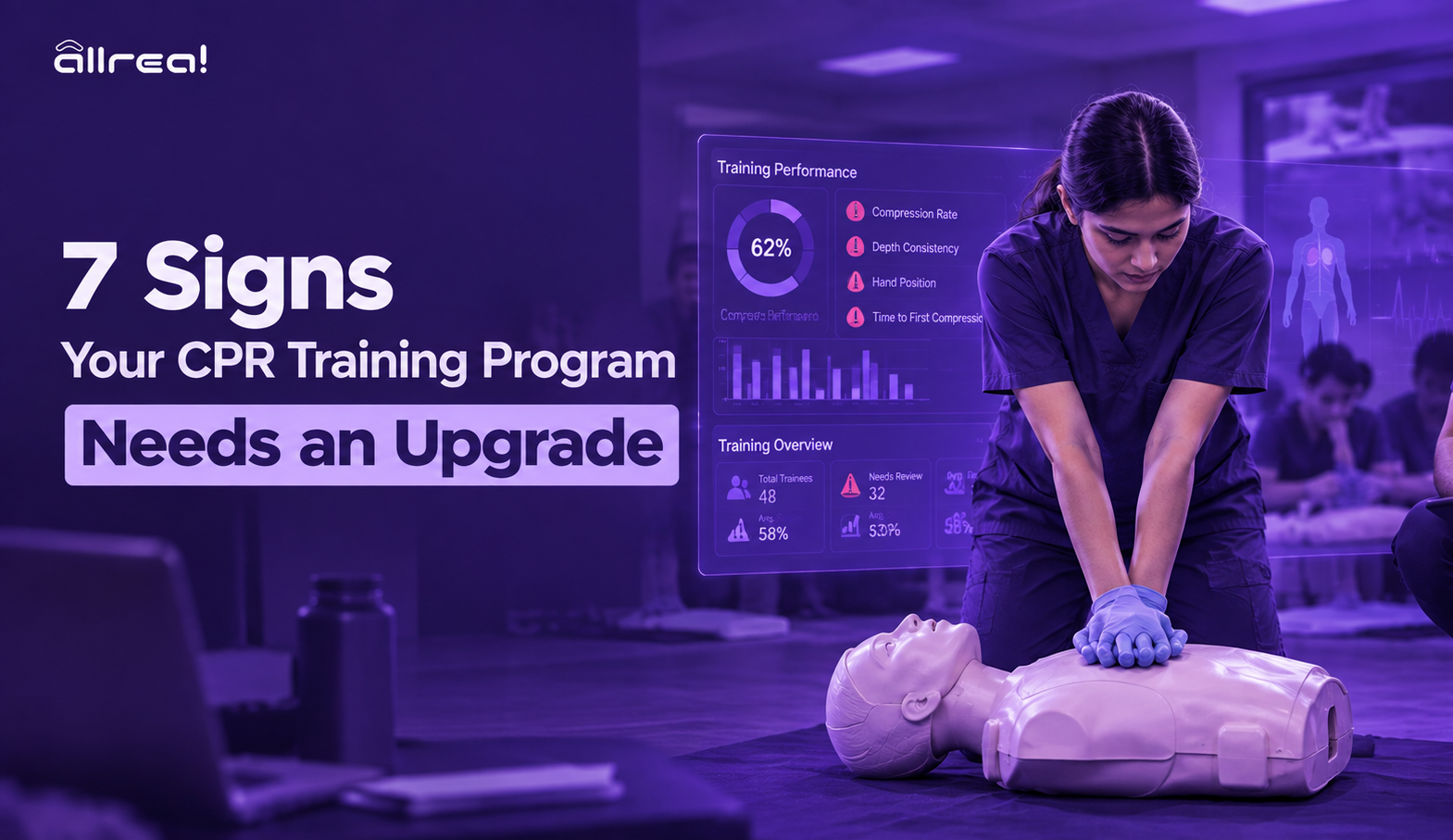
A healthcare professional can complete a training program, pass an assessment, and receive a certification. But one important question can still remain unanswered: How well can they actually perform the skill when it matters?
Healthcare institutions have become increasingly good at collecting training data attendance records, course completion, assessment results, certification status, and training hours. Yet the most valuable part of healthcare skills training often happens beyond the training record: during hands-on practice, when a learner performs a clinical skill, makes decisions, responds to feedback, and improves through repetition.
This creates a missing data layer in healthcare training.
Knowing that someone completed CPR training, for example, does not provide the same insight as knowing how accurately they performed chest compressions, where their technique needs improvement, or whether their performance changed after additional practice. This is where clinical skills assessment, simulation-based training, objective feedback, and performance analytics become increasingly important.
As healthcare education moves toward more measurable approaches, the question is no longer simply whether training was completed. It is whether training produced observable improvement and whether institutions have the data to understand that performance.
The shift is from tracking training to measuring performance. And that missing layer could play an important role in building more informed, effective, and measurable healthcare skills training programs.
What Does the “Data Layer” Mean in Healthcare Training?
Healthcare training generates a considerable amount of information. Training departments may know who attended a session, who completed a course, when a certification was issued, and whether a learner passed an assessment. These records are important for managing education and compliance, but they do not always tell the full story of what happened when a learner actually performed a skill.
That distinction is becoming increasingly important as healthcare education moves toward more measurable forms of skills development
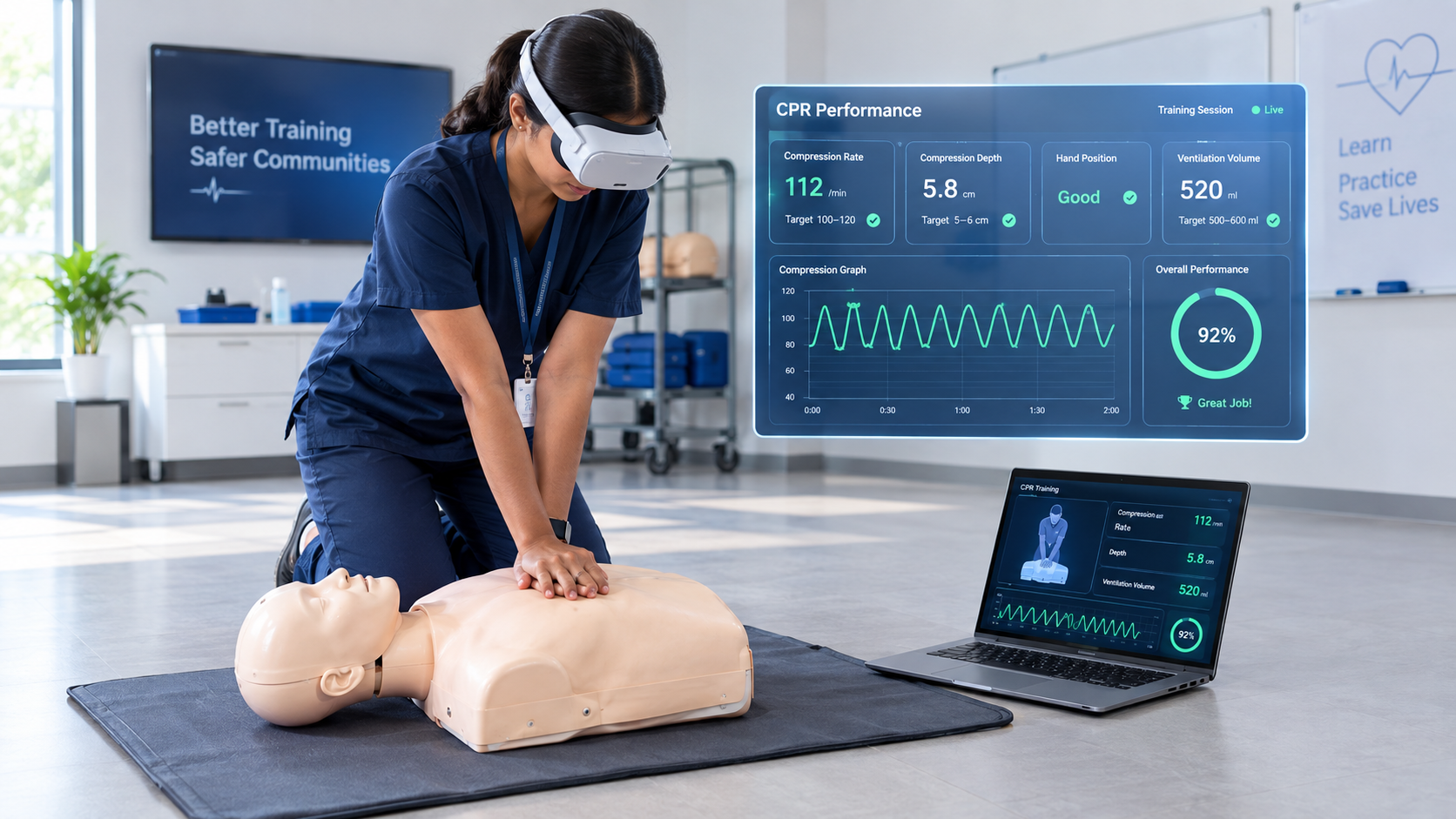
Consider CPR training as a simple example. A hospital may know that a healthcare professional completed a CPR course and passed the required assessment. However, that record does not necessarily show how consistently the person performed chest compressions during practice, whether compression depth and rate were appropriate, or how performance changed after receiving feedback.
This is where a data layer in healthcare skills training becomes valuable.
The term does not necessarily refer to one particular software platform or technology. It describes the information generated when a learner's actual performance is captured, measured, and interpreted alongside the training record.
In other words, traditional training data tells an institution that training happened. A performance data layer can provide greater visibility into what happened during the training itself.
Why Training Completion Doesn't Tell the Whole Story
Completing a healthcare training program is an important milestone, but it is not the same as demonstrating consistent competency. A completion record can confirm that a learner attended the required training, completed the assessment, and met the program requirements. What it may not show is how effectively that person can perform the skill during hands on practice or whether that performance is maintained over time.
This creates an important distinction between completion, competency, and readiness.
Completion means the required training has been completed. Competency goes a step further by asking whether the learner can perform the required skill to an expected standard. Readiness considers whether that capability can be applied when the situation demands it.
These stages are connected, but they are not interchangeable.
The 2025 American Heart Association make this distinction particularly relevant to resuscitation training. The guidelines note that resuscitation programs can provide opportunities to practice critical skills, yet performance does not always consistently translate into real world environments. They also recommend CPR feedback devices during training because objective, real time information can provide a clearer picture of performance than visual observation alone.
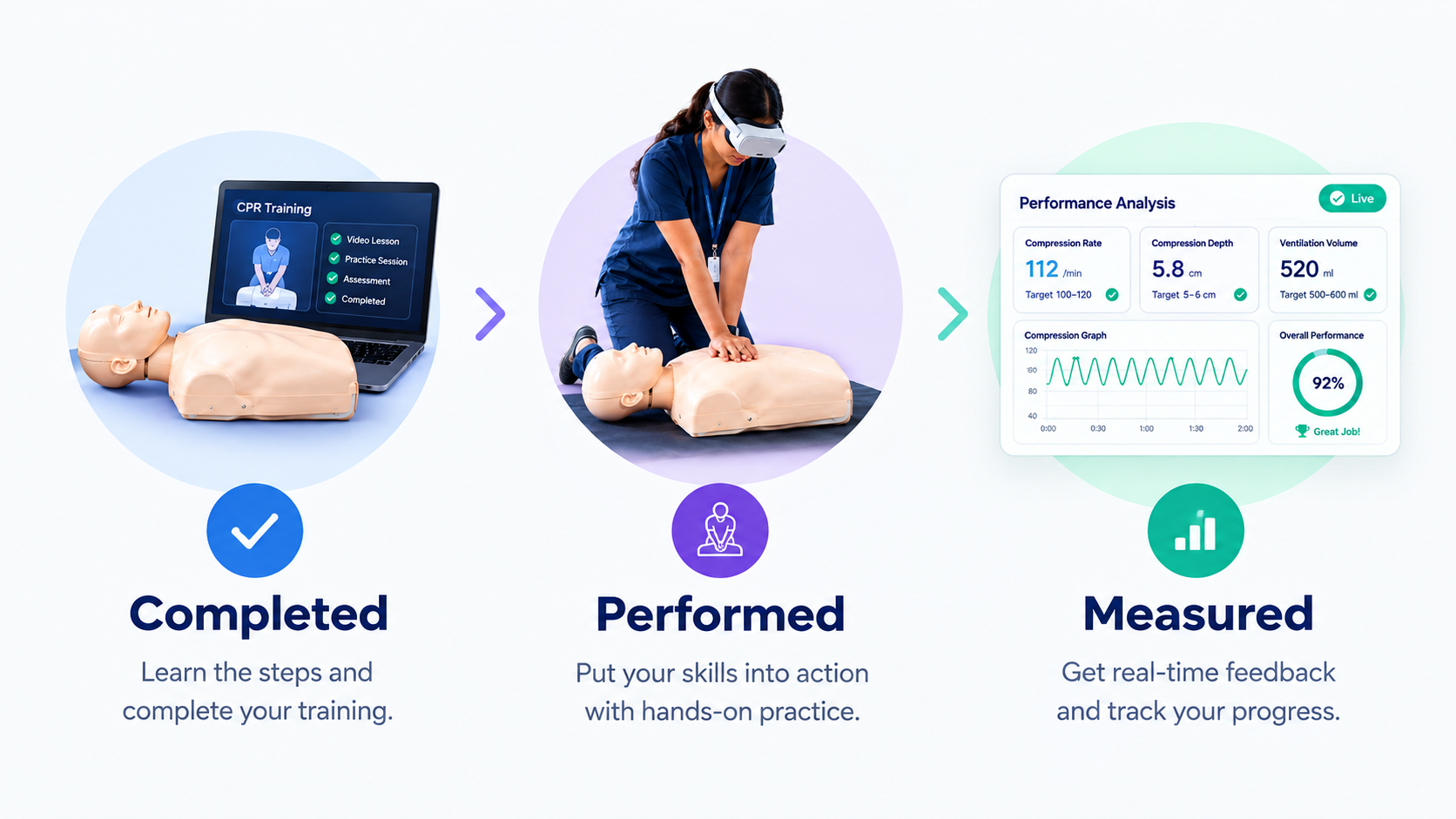
The point is not that completing training has little value. It is that completion records alone provide limited visibility into hands on performance.
For healthcare institutions, this means the training record should not necessarily be the end of the measurement process. It can be the starting point for understanding whether knowledge has translated into practical skill, whether that skill is improving with practice, and where additional training may be needed.
Ultimately, the shift is from simply asking “Was the person trained?” to asking “What can the person demonstrate?”
What Healthcare Skills Can Actually Be Measured?
Not every healthcare skill can be reduced to a single score, but many hands on skills contain observable elements that can be measured consistently. This is one of the advantages of simulation based education. Instead of assessing only whether a learner knows what to do, educators can examine how the learner performs while carrying out the task.
CPR and Resuscitation Skills
CPR is one of the clearest examples because several aspects of performance can be measured objectively. Depending on the training equipment being used, systems can capture variables such as compression depth, compression rate, chest recoil, compression fraction, and the consistency of compressions.
These measurements can provide information that is difficult to obtain from a training record alone. A learner may understand the correct technique, for example, while still producing inconsistent compression depth during practice. Objective measurements can make that difference visible and give both the learner and instructor something specific to work on.
The 2025 American Heart Association recommend the use of feedback devices during CPR training, reflecting the growing importance of objective performance information in resuscitation education.
Procedural and Simulation Based Skills
The same principle can apply to other clinical skills, although the metrics will depend heavily on the procedure and the simulation system.
A simulation environment can potentially capture information about the sequence of procedural steps, time taken to complete a task, decisions made during a scenario, communication between team members, and responses to changing conditions.
For example, a simulated emergency scenario may reveal that a learner knows the appropriate intervention but takes too long to recognise a deterioration in the patient's condition. A team based simulation may reveal communication or coordination issues that would be difficult to identify through a written assessment.
The value of this data is not that every action needs to become a number. It is that important aspects of practical performance can be made more visible, giving educators a stronger basis for assessment and improvement.
What Happens When Training Data Becomes Performance Data?
Once performance information is captured consistently, its value extends beyond a single training session. It can help training teams understand patterns across learners, identify recurring weaknesses, and make better decisions about where practice and support are needed.
Identify Skill Gaps Earlier
Performance data can help educators identify specific areas of difficulty before they become recurring problems in training. Instead of treating a learner's performance as simply satisfactory or unsatisfactory, instructors can look at the particular part of a skill that requires attention.
This makes remediation more targeted. A learner who struggles with one aspect of a procedure may need a different intervention from someone who has difficulty with the entire process.
Personalize Remediation
Not every learner benefits from exactly the same amount or type of practice. Performance information can help instructors determine where additional coaching may be useful and whether a learner has improved after that intervention.
This supports a more individual approach to skills development rather than treating every learner as though they has the same training needs.
Track Improvement Over Time
A single assessment provides a snapshot. Repeated performance data can provide a much broader picture.
When results from multiple practice sessions are available, educators can examine whether performance is becoming more consistent, whether particular weaknesses are improving, and whether additional practice is producing measurable changes.
This is particularly useful in simulation environments where learners can practise repeatedly without exposing patients to unnecessary risk.
Support Training Decisions With Evidence
At an institutional level, performance data can also change how training programmes are evaluated.
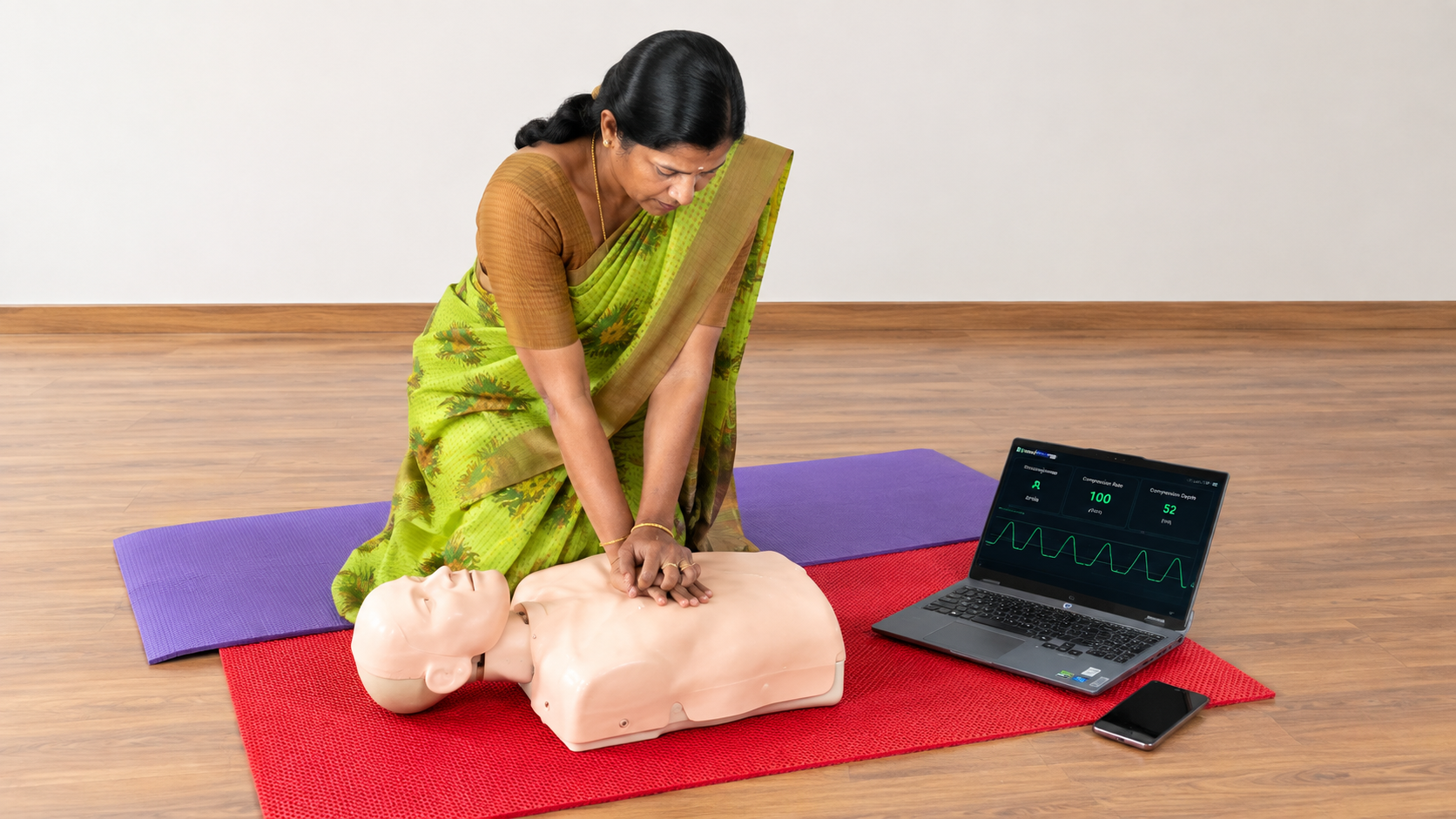
Instead of relying primarily on attendance numbers, completion rates, or general feedback, training teams can examine what learners are actually demonstrating during practice. The question becomes less about how much training was delivered and more about what the training is helping learners achieve.
That shift can give healthcare education teams a stronger foundation for deciding where to invest training time, which skills need reinforcement, and how simulation programmes can be improved.
The Role of Real Time Feedback in Skills Training
Measuring performance is useful, but measurement becomes considerably more valuable when learners can act on the information while they are still practising.
This is where real time feedback plays an important role. Instead of waiting until the end of a session to discover that a technique needs improvement, learners can receive information during the activity itself and adjust their performance accordingly.
In CPR training, for example, feedback can indicate whether compressions are within the appropriate depth and rate range. The learner can then make an immediate adjustment and observe whether the change improves their performance.
An instructor can interpret why a learner is struggling, provide context, correct technique, answer questions, and adapt the teaching approach to the individual. Technology can provide objective information that supports that process.
The strongest approach is therefore not technology versus instructor. It is objective measurement combined with informed instruction.
When the two work together, feedback becomes more than a score on a screen. It becomes part of the learning process itself, helping learners understand what they are doing, where they need to improve, and whether their next attempt is actually better.
From Individual Scores to Training Intelligence
The real value of training data begins to emerge when it is viewed beyond a single learner.
If performance information is collected consistently, training teams can start identifying patterns across groups, departments, and training programmes. They may be able to see which skills frequently require additional practice, where performance gaps appear repeatedly, or whether learners improve after a particular type of intervention.
Over time, this can help answer questions that individual assessment cannot. Are the same skills creating difficulties across multiple training sessions? Does one department require more focused practice? Are performance gaps narrowing after remediation? How often should a particular skill be revisited?
This is where training intelligence becomes useful. It is not about predicting outcomes or replacing professional judgement. It is about turning training information into insights that can help educators make more informed decisions about practice, assessment, and programme design.
What a Useful Healthcare Training Data Layer Should Capture
A useful data layer should capture information that helps explain how a learner is developing, rather than simply recording whether training was completed.
Depending on the skill and technology involved, this may include:
1. Performance: What did the learner demonstrate?
2. Consistency: Was the skill performed reliably?
3. Progress: Did performance change across practice sessions?
4. Skill gaps: Which areas require further attention?
5. Assessment results: How did the learner perform against defined criteria?
6. Practice frequency: How often has the skill been practised?
7. Remediation: What additional training or coaching was provided?
8. Readiness indicators: What available evidence suggests about current performance?
Not every training programme needs all of these measures. The right data depends on the skill being taught, the learning objective, and the capabilities of the assessment system.
The goal is not to collect the most data. It is to collect data that can support better training decisions.
Where Simulation and Smart Training Technology Fit
This is where simulation technology can connect the physical experience of practice with measurable digital information.
A learner can perform a skill using a simulator or smart manikin while sensors capture relevant performance data, software processes that information, and analytics help present it in a form that instructors and learners can understand.
For CPR training, for instance, a smart manikin can provide information about aspects of compression performance that would otherwise need to be estimated through observation. In more complex simulation environments, technology can also support the recording of actions, timing, decisions, and responses within a scenario.
Immersive technologies such as Mixed Reality can add another dimension by placing learners within interactive situations while maintaining a controlled training environment. The technology itself, however, is only one part of the equation. Its real value comes from how the resulting information is used to teach, assess, practice, and improve skills.
How allreal Approaches the Data Gap
For healthcare institutions, the value of training technology is not simply in making practice more digital. It is in helping training teams create a more structured, measurable, and consistent approach to practical skills development.
This is where allreal’s RescueSim ecosystem fits into the training process.
RescueSim Lite provides a practical way for hospitals, universities, and training institutes to introduce measurable CPR practice into their existing training environments. It combines a smart CPR manikin with a desktop or web-based platform, providing step by step guidance, real time performance feedback, metrics, scoring, and CPR competency evaluation without requiring a Mixed Reality headset.
For training teams, this means CPR practice can be supported by objective performance information rather than relying entirely on observation. Instructors can use this information alongside their own assessment and feedback, while learners can better understand where their technique needs attention.
RescueSim XR takes this approach further by combining a smart, high-fidelity manikin with Mixed Reality scenarios, training software, and cloud based performance analytics. Learners can practise CPR within simulated emergency environments such as a metro station, park, or gym while the system provides real time feedback on aspects including compression depth, rate, and recoil.
For institutions, the value extends beyond the individual training session. RescueSim XR can provide a more immersive environment for structured practice, objective evaluation, and performance review, giving training teams another way to understand how learners perform within simulated emergency situations.
The two systems therefore support different institutional needs. RescueSim Lite offers a simpler approach to smart CPR practice and measurement, while RescueSim XR combines those capabilities with immersive emergency scenarios.
For hospitals and healthcare training organisations, this can support a more organised approach to CPR education by helping teams:
· Evaluate Practical Performance More Objectively
· Provide Learners with Specific Performance Feedback
· Monitor Progress Across Repeated Practice
· Identify Areas That May Require Additional Attention
· Create More Structured Simulation Experiences
· Gain Greater Visibility Into Hands On Cpr Practice
RescueSim is not intended to replace instructors or reduce clinical skills to a single score. Its role is to provide technology supported measurement and feedback that can complement instructor led training.
For organizations looking to make CPR education more measurable, RescueSim offers a way to connect the physical practice of CPR with the digital information needed to understand and evaluate that practice.
The Future of Healthcare Skills Training Is More Measurable
The future of healthcare training is not necessarily about replacing traditional teaching with technology. It is about giving educators and institutions better ways to understand and support practical skill development.
For hospitals, universities, training centres, and healthcare organisations, this can mean moving toward training environments where practice is supported by objective feedback, measurable performance, and structured evaluation.
Solutions such as RescueSim demonstrate how this can work in CPR training. Instead of limiting the training experience to a physical manikin and instructor observation, institutions can combine smart manikin technology, software, performance feedback, and, where appropriate, immersive simulation.
This also creates flexibility for different training environments. A desktop based system such as RescueSim Lite can support accessible CPR practice, while RescueSim XR can introduce immersive emergency scenarios for organisations looking for a more advanced simulation experience.
The broader opportunity for healthcare institutions is to build training programmes where technology supports instructors rather than replaces them.
The goal is not simply to conduct more training sessions.
It is to create better visibility into practice, better opportunities for improvement, and a more measurable training process.
Conclusion: Building the Missing Layer
Healthcare skills training is becoming increasingly connected to technology, but the real opportunity lies in how that technology supports the people responsible for training and assessment.
For institutions, measurable skills training can provide a stronger foundation for understanding how learners practise, where they need support, and how training environments can evolve.
This is the space allreal is addressing through RescueSim.
With RescueSim Lite, organisations can introduce smart CPR practice, real time feedback, scoring, and performance measurement through a desktop or web based platform.
With RescueSim XR, those capabilities are combined with Mixed Reality scenarios, a smart high fidelity manikin, and cloud based analytics to create a more immersive CPR simulation experience.
Together, these approaches show how CPR training can move beyond a simple practice session and become a more structured experience built around practice, feedback, measurement, and improvement.
For healthcare organisations, the question is no longer only how training is delivered. It is also how effectively technology can support instructors, engage learners, and provide meaningful insight into practical skill development.
The missing data layer is therefore not about collecting data for its own sake.
It is about using the right information to make healthcare skills training more measurable, more informed, and more useful for the organisations delivering it.
Bring Measurable CPR Training to Your Institution
Move beyond simply recording training completion. Explore how RescueSim Lite and RescueSim XR can support measurable CPR practice, real time feedback, performance evaluation, and immersive simulation.
Talk to allreal about bringing RescueSim to your training environment